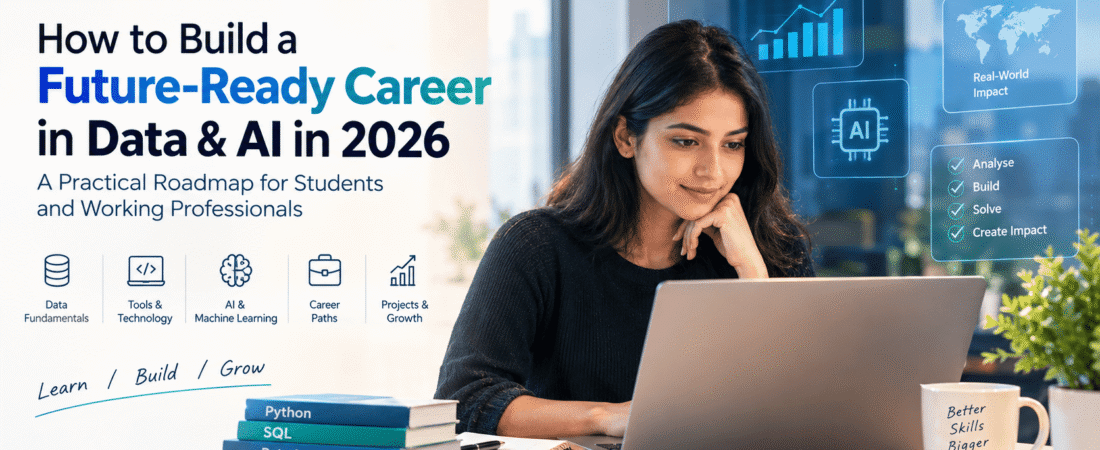
The way we work with technology is changing rapidly. Businesses across industries are using data, artificial intelligence, automation, and analytics to make faster and more informed decisions. As a result, professionals who can understand data and apply AI to real business problems are becoming increasingly valuable.
For students and working professionals, this creates an exciting opportunity—but also an important question:
What skills should you learn to build a successful career in Data and AI in 2026?
The answer is not simply “learn AI.”
A future-ready career requires a combination of data fundamentals, analytical thinking, technical skills, AI knowledge, business understanding, and practical experience.
This guide explains a practical roadmap to help you get started.
Why Data and AI Skills Matter in 2026
Data is now part of almost every modern business function. Companies use it to understand customers, improve operations, manage risk, forecast demand, measure performance, and develop new products.
At the same time, AI is changing how professionals work with that data. AI-powered tools can help automate repetitive tasks, identify patterns, generate insights, and support decision-making.
This does not mean that learning traditional data skills is becoming less important. In fact, the opposite is increasingly true.
To use AI effectively, professionals need to understand the data behind the problem, evaluate the quality of information, interpret results, and apply critical thinking.
Recent hiring trends in India also show a growing focus on practical skills and job readiness rather than qualifications alone.
Step 1: Understand the Data Fundamentals
Before jumping into advanced AI or machine learning, build a strong foundation in data.
Start by understanding:
- Data types and structures
- Data collection and cleaning
- Basic statistics
- Data interpretation
- Descriptive and diagnostic analytics
- Data visualisation
- Business metrics and KPIs
These fundamentals help you understand what the data is saying before using advanced tools to analyse it.
For example, knowing how to calculate an average is useful. But knowing whether the average is actually meaningful for a business decision is even more important.
This is where analytical thinking becomes valuable.
Step 2: Learn the Tools Used in Real-World Analytics
Once you understand the fundamentals, start working with practical tools.
Some important skills include:
Excel
Excel remains useful for data analysis, reporting, modelling, and business operations. It is often a good starting point for beginners.
SQL
SQL is essential for working with data stored in relational databases. It allows analysts to retrieve, filter, join, aggregate, and analyse information.
Python
Python has become one of the most widely used programming languages for data analysis, machine learning, automation, and AI.
You do not necessarily need to become an advanced software engineer to begin using Python for data work. Start with the basics and gradually move into libraries and frameworks used for analytics and machine learning.
Step 3: Move From Analytics to AI and Machine Learning
After developing your data foundation, you can explore machine learning and AI.
Machine learning allows computers to identify patterns from data and use those patterns to make predictions or support decisions.
Depending on your career goals, you can explore areas such as:
- Supervised and unsupervised learning
- Regression and classification
- Clustering
- Model evaluation
- Natural language processing
- Deep learning
- Generative AI
- AI-powered automation
You do not have to learn everything at once.
A better approach is to choose a specific career direction and build the skills required for that role.
Step 4: Choose the Right Career Path
“Data and AI” is a broad field. There are multiple career paths you can explore.
Data Analyst
Data analysts work with datasets to identify trends, generate reports, build dashboards, and support business decisions.
Business Analyst
Business analysts connect business requirements with data and technology to help organisations improve processes and make better decisions.
Data Scientist
Data scientists use statistics, programming, machine learning, and domain knowledge to solve complex problems using data.
Machine Learning Engineer
Machine learning engineers focus on developing, deploying, and maintaining machine learning systems.
AI and Generative AI Roles
The growth of generative AI is also creating opportunities around AI applications, automation, AI products, natural language processing, and intelligent systems.
The right choice depends on your current background, interests, and career goals.
Step 5: Build Projects Instead of Only Collecting Certificates
One of the biggest mistakes learners make is focusing entirely on completing courses.
A certificate can demonstrate that you completed a learning program, but a project can demonstrate what you can actually do.
Try building projects based on realistic business problems.
For example:
- Analyse e-commerce sales data
- Build a customer dashboard
- Predict customer churn
- Analyse financial transactions
- Create a demand forecasting model
- Build a healthcare analytics dashboard
- Develop an AI-powered recommendation system
- Use generative AI to automate a business workflow
A strong project should explain three things:
What was the problem?
How did you use data or AI to solve it?
What insight or result did you produce?
This approach helps you build a portfolio that you can discuss during interviews.
Step 6: Develop Business and Communication Skills
Technical knowledge is only one part of becoming a successful data professional.
You also need to communicate your findings clearly.
Imagine that you discover an important trend in a company’s customer data. If you cannot explain what the trend means and what the business should do next, the analysis has limited value.
Develop skills in:
- Problem-solving
- Critical thinking
- Business communication
- Presentation
- Storytelling with data
- Collaboration
- Decision-making
These skills become even more important as AI tools become more capable.
Professionals need to know when to trust an AI-generated result, when to verify it, and when human judgement is required.
Step 7: Keep Learning as Technology Changes
Data and AI are evolving quickly.
The tools you learn today may change tomorrow, so the goal should not be to memorise a fixed list of technologies.
Instead, develop the ability to learn new tools quickly.
A good learning cycle is:
Learn → Practise → Build → Review → Improve
Spend less time simply watching tutorials and more time applying what you learn.
For students, this could mean building projects alongside their degree.
For working professionals, it could mean applying analytics or AI to problems within their current industry.
A Practical Roadmap for Beginners
If you are starting from zero, you do not need to learn everything immediately.
A simple roadmap could look like this:
Stage 1 — Foundations
Learn data concepts, Excel, statistics, and analytical thinking.
Stage 2 — Analytics
Learn SQL, Python basics, data cleaning, visualisation, and business intelligence.
Stage 3 — Projects
Work with real datasets and build portfolio projects.
Stage 4 — Advanced Skills
Explore machine learning, AI, deep learning, or generative AI depending on your career goal.
Stage 5 — Career Preparation
Build your portfolio, improve your resume, practise interviews, and learn how to communicate your projects effectively.
Why Practical, Industry-Aligned Learning Matters
The best learning approach is one that connects concepts with real-world applications.
At The Data Institute, the focus is on helping students and working professionals develop practical, industry-aligned skills across data, analytics, and applied AI.
The institute offers learning pathways across areas such as FinTech Analytics, AgriTech Analytics, Supply Chain Analytics, Healthcare Analytics, Pharma Analytics, and Social Impact Analytics, allowing learners to understand how data and AI can be applied to different industries.
This industry-focused approach can help learners move beyond simply understanding tools and start thinking about how those tools can solve real problems.
Final Thoughts
Building a career in Data and AI in 2026 is not about learning every new AI tool or chasing every technology trend.
It is about developing a strong foundation and learning how to apply technology to meaningful problems.
Start with data fundamentals. Learn practical tools such as Excel, SQL, Python, and business intelligence. Gradually move into machine learning and AI. Most importantly, build projects, develop problem-solving skills, and learn to communicate your insights.
Whether you are a student planning your first career, a graduate preparing for your next opportunity, or a working professional looking to transition into a data-driven role, the journey starts with one step:
Learn the fundamentals. Build practical skills. Solve real problems. Keep adapting.
The future belongs not simply to people who know AI, but to people who know how to use data and AI to create meaningful outcomes.